
I added links just in case you are confused about what I’m saying.
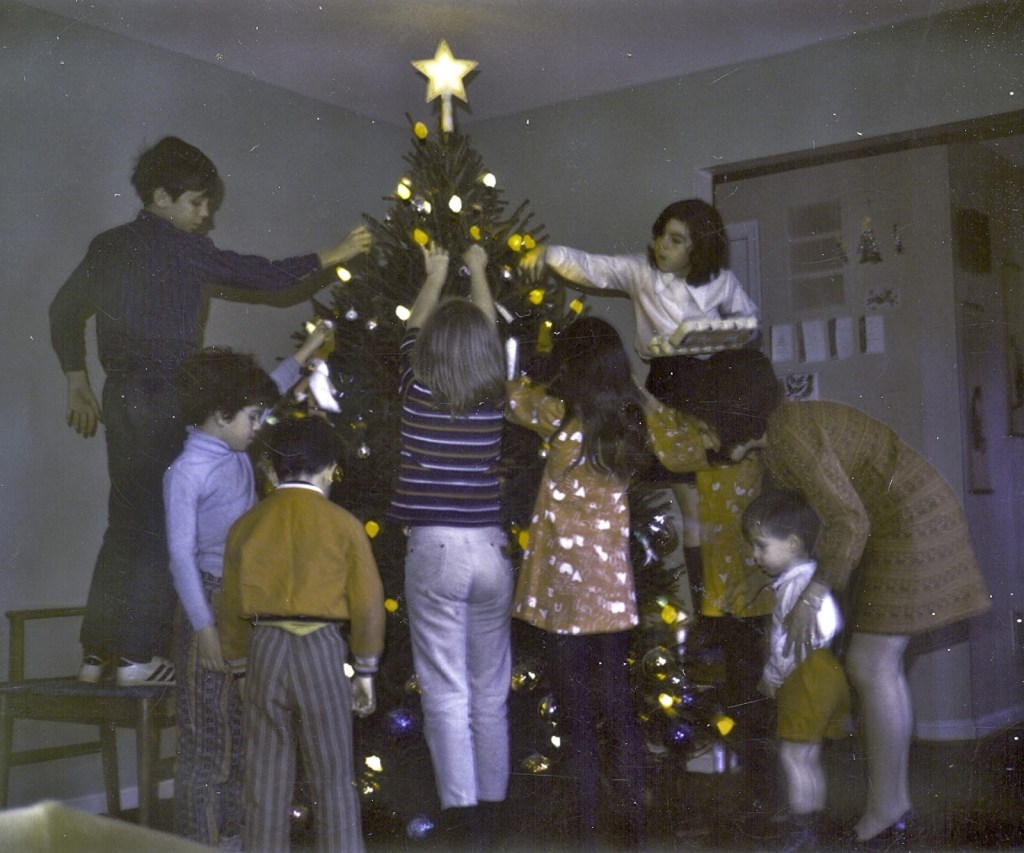
A family decorating a Christmas Tree, unaware that their camera would become colorblind, circa 1970s.
Sitting around the fire in your cabin, drinking your seemingly infinite hot chocolate, in your family’s living room, you see the big attraction this Christmastime—the big ol’ Christmas tree. Then, you ask yourself, “Where did this custom come from?” Contrary to popular belief, it wasn’t a commercial venture at all. Let me burn the rumours to embers as I tell you, the story of the Christmas tree.
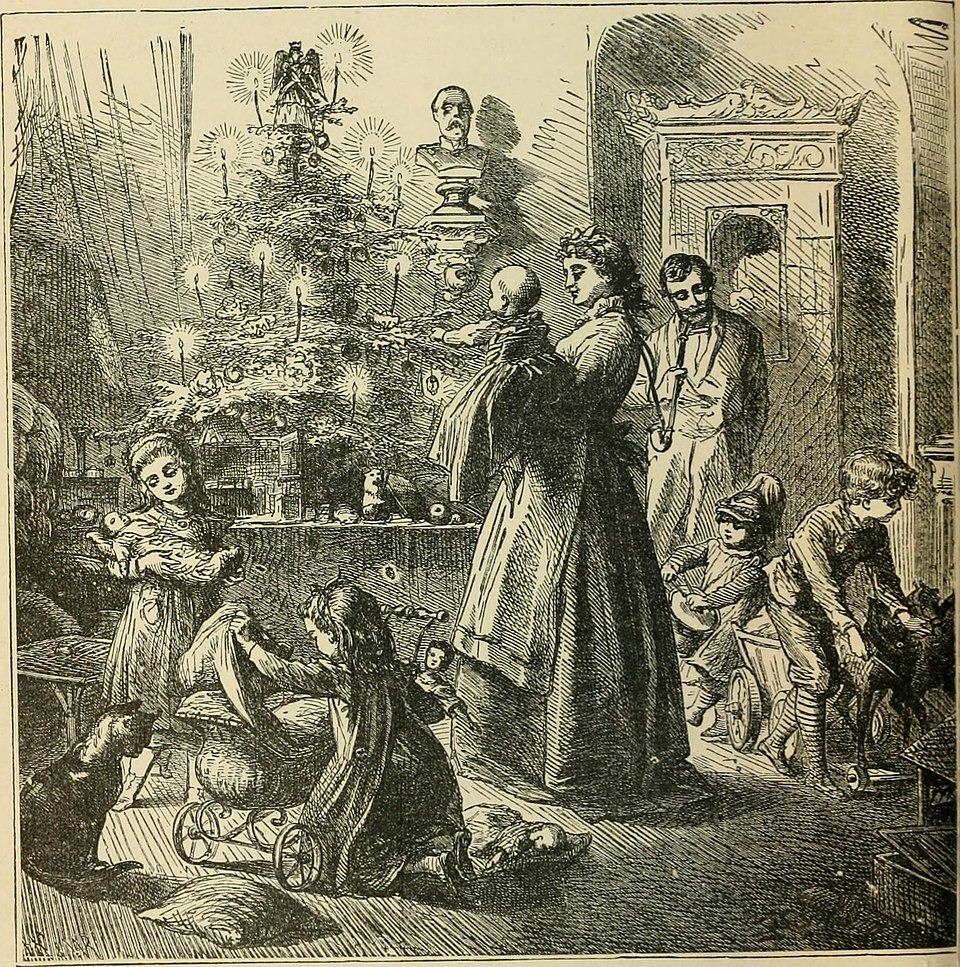
Illustration of a Christmas tree in Germany, 1888
To no historian’s surprise, the modern Christmas tree actually originated in Central Europe and the Baltic States (how’s that Anglophonics?) The earliest record of Christmas trees was their usage by German Lutherans, being placed in the Cathedral of Strasbourg by Protestant Reformer Martin Bucer in 1539. The earliest known depiction resembling a Christmas tree is found on a keystone sculpture in a private home in Turckheim, Alsace, which was then part of the Holy Roman Empire and is now in France. It is even stated in legend that Martin Luther created the concept altogether.
However, its origins go way deeper…
Modern Christmas trees have been connected to the “tree of paradise” of medieval era mystery plays on Christmas Eve, which was, back then, the celebration and name day of Adam and Eve in many nations (if they existed as a concept back then). In these aforementioned mystery plays, the tree was decorated with apples, symbolizing the tree of paradise. Consequently, Adam and Eve were banished from the Garden of Eden after they ate from the tree of “”””paradise””””, thus giving humanity original sin that is removed via baptism. Also, white wafers were used on set, symbolizing the Eucharist and redemption. Alongside nativity plays, the trees were moved to homes, with the red apples being put back on market stalls and replaced with the modern Christmas ornaments we know today.
Another connection is made with the pagan religions of Northern and Slavic Europe. Tree worship was common in pagan households and survived their conversion to Christianity, decorating their homes with evergreen trees to scare away the devil. Meanwhile, in Slavic-influenced regions of Europe, particularly Poland, there is a pre-Christian tradition of suspending branches of fir, spruce, or pine from the ceiling rafters. This tradition is called podłaźniczka, and it is mainly used in the region of Lesser Poland. This tradition is also used in Slovakia.
So, we have killed the rumours about its origins (may they suffer in debunking hell), it’s time to ask… why is it popular now?
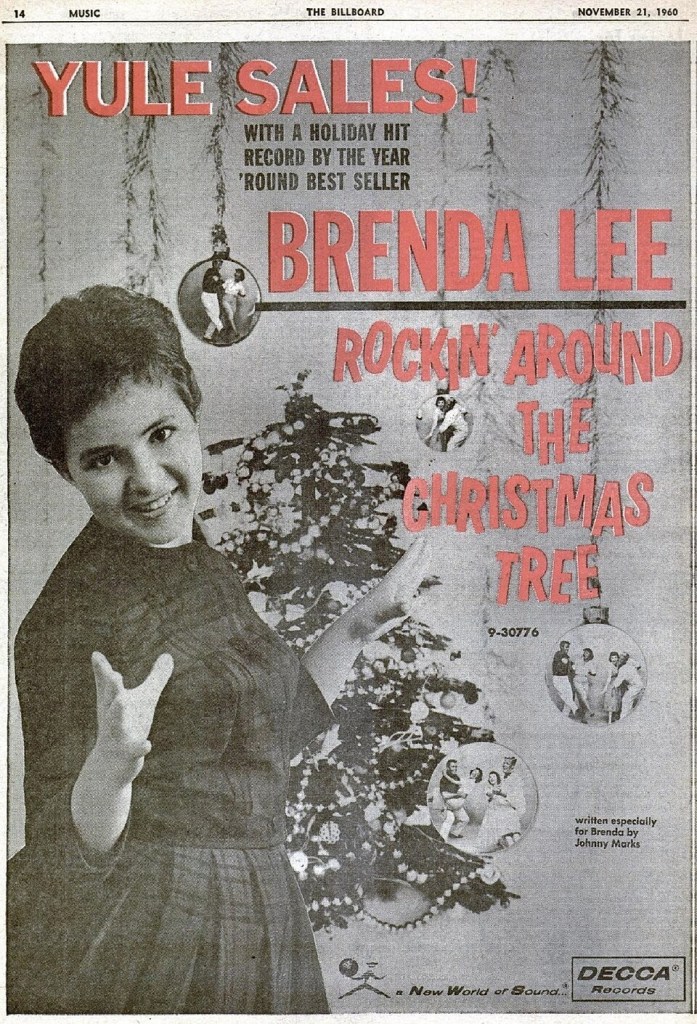
An advertisement for Brenda Lee’s hit Christmas song, Rockin’ Around the Christmas Tree (1958), advertisement, Nov. 21, 1960
In the early 19th century, the custom of a Christmas tree became popular among the nobility and royal courts of Christian Europe, as far as Russia. Fanny von Arnstein introduced it, and Princess Henrietta of Nassau-Weilburg introduced it. The tradition arrived in Vienna in 1814, while the Congress of Vienna was being held, and it spread across Austria for the next couple of years. A few decades later, it spread to France in 1840 by the duchesse d’Orléans. Denmark claims that it adopted the custom early in 1808, when the Countess Wilhelmine of Holsteinborg lit it. The countess, later in her life (1865), gave it to Danish fairy-tale writer Hans Christian Andersen. He then published it as The Fir-tree in 1844.
It spread everywhere, starting in Germany, all the way to Italy, and into North America, introduced by Hessian soldiers during the Revolutionary War (more specifically, the Quebec campaign). However, it didn’t become really popular until it was brought to Britain.
Prince Albert, husband of Queen Victoria, and also a German, used Christmas Trees for Christmas in Buckingham Palace. While it had been used before (Queen Victoria fondly remembered it) but it was her marriage to Prince Albert in 1841 that made it skyrocket, as Albert taught Victoria on setting up the Christmas tree (including the hazardous candles), many middle-class families started to adopt the tradition, and it was linked to German origins, gift-giving, and…. Their smart cachet?
A few years later, in America, Benjamin Harrison used the first Christmas tree in the White House. Cool. Also in America, over time, entire towns disputed over who lit up the first tree. Some say it’s Windsor Locks in Connecticut, others say it’s Easton in Pennsylvania. In his diary, Matthew Zahm, from Lancaster, Pennsylvania, recorded the use of a Christmas tree in 1821. Whatever the story, the real origin of Christmas trees in America is up above this article.
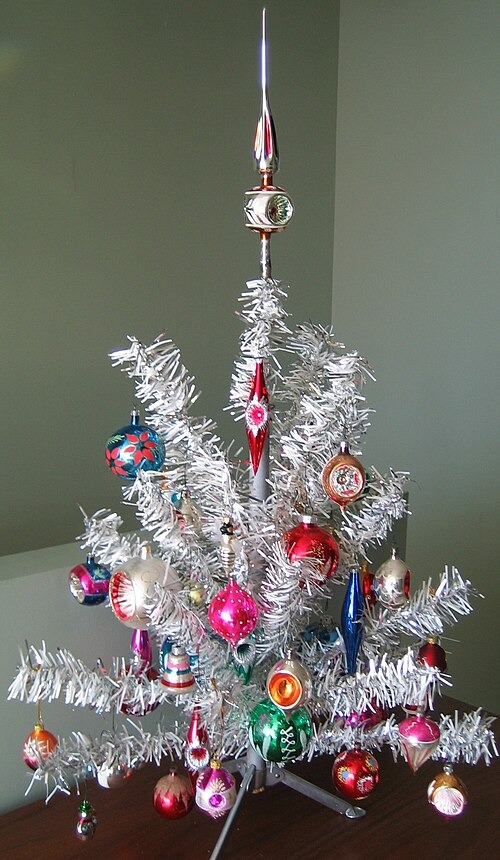
A vintage aluminum Christmas tree. What did you expect?
Fast forward to the 20th century, and the beginnings of Christmas commercialization were taking place. In the late 19th century, there was a fad of feather Christmas trees, made of feathers, obviously. (More specifically, green-dyed goose feathers), But surely, it’s just a warning shot; it’s not deadly, right?
And the commercialization invasion is underway. To put it simply, there has been significant progress in the trees. The trees are now in different colors. The problem is, they are made of aluminum. First manufactured in 1958 in Chicago and later in Manitowoc, Wisconsin, aluminum trees were all the rage, as they were pre-built, cheap, and came with a light show via a color wheel. It slowly died out due to its humiliating presence in the 1965 Peanuts special, A Charlie Brown Christmas, where it symbolized the destructive commercialization of the holiday (ironic, as it was commissioned by Coca-Cola). Despite its great satire, it didn’t really die out until the 1970s.
Nowadays, alternatives are offered, usually made of PVC or plastic. It isn’t as good as a real tree, but even though it has all the “perks” of its aluminum predecessors (but it lacks its prebuilt status), it’s completely sanitized to make it feel… decent. I mean, it’s GREEN!
And that is the origin of the Christmas tree. Now, you can sit back and relax.
Merry Christmas.

Leave a Reply